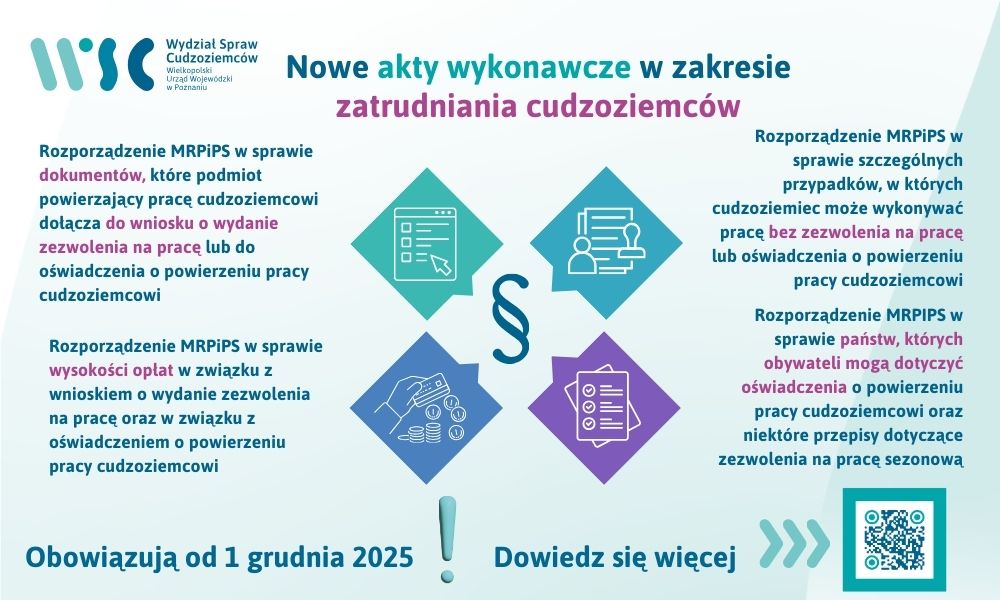











Please be informed that on 1 December 2025, new regulations to the Act on the conditions of admissibility of entrusting work to foreigners in the territory of the Republic of Poland (in force since 1 June 2025) will come into effect, replacing the previously applicable implementing acts:
- Regulation of the Minister of Family, Labour and Social Policy of 20 November 2025 on specific cases in which a foreigner entitled to stay in the territory of the Republic of Poland may perform work without a work permit or a declaration on entrusting work to a foreigner (Journal of Laws 2025, item 1620)
- Regulation of the Minister of Family, Labour and Social Policy of 20 November 2025 on the amount of fees related to a work permit application and to a declaration on entrusting work to a foreigner (Journal of Laws 2025, item 1622)
- Regulation of the Minister of Family, Labour and Social Policy of 21 November 2025 on the countries whose citizens may be covered by declarations on entrusting work to a foreigner and certain provisions concerning seasonal work permits (Journal of Laws 2025, item 1617)
The main changes concern the declaration of entrusting work procedure, increased fees and clarification of specific cases of work exempt from the requirement to obtain a permit.
Additionally, on 1 December 2025, the Regulation of the Minister of Family, Labour and Social Policy of 20 November 2025 on documents that an entity entrusting work to a foreigner must attach to a work permit application or to a declaration on entrusting work to a foreigner (Journal of Laws 2025, item 1629) will also take effect. This regulation replaces previous provisions, clarifies, and systematizes documentation requirements in line with the new Act on the conditions of admissibility of entrusting work to foreigners.
Changes to the declaration procedure for entrusting work to foreigners
A declaration on entrusting work to a foreigner is a simplified procedure, compared to a work permit, for legalizing work in Poland. It is issued by the local county labour office (not by the voivodeship office as in the case of a work permit), competent for the employer’s registered office (for companies registered in the National Court Register) or permanent residence (for natural persons and sole proprietors registered in CEIDG).
However, the declaration procedure has important limitations: it applies only to citizens of a few countries indicated in a regulation of the minister responsible for labour, issued in consultation with the minister responsible for internal affairs.
From December 2025, this list will be reduced. Under the new regulation on countries whose citizens may be covered by declarations and certain provisions on seasonal work permits, declarations may only concern citizens of:
- Republic of Armenia
- Republic of Belarus
- Republic of Moldova
- Ukraine
Higher fees for declarations and work permits
Another regulation entering into force on 1 December 2025 is the regulation on the amount of fees for work permit applications and declarations on entrusting work to a foreigner.
From 1 December 2025, the fee submitted with a declaration will be 400 PLN (previously 100 PLN).
Cases already initiated before the effective date will follow the previous rules.
Work permit application fees will also change on 1 December 2025:
- 200 PLN – for work permits up to 3 months
- 400 PLN – for work permits longer than 3 months
- 800 PLN – for delegations of foreign workers to Poland
- 100 PLN – for seasonal work permits
Precise specification of cases exempt from work permits
The new regulation (issued under Article 3(7) of the Act of 20 March 2025) clarifies the special cases where foreigners can work without a work permit, complementing the statutory provisions introduced on 1 June 2025. These include:
- Participation in EU and international assistance programmes (programme development/supervision or training)
- Teachers conducting instruction in foreign languages – clarified with reference to the Education Law and specific types of institutions
- Delegation connected with defence programmes under agreements involving Poland
- Journalists – foreign correspondents accredited by the Ministry of Foreign Affairs
- Artistic and audiovisual work – with explicit limits (up to 30 days per calendar year)
- Occasional lectures/speeches/presentations – also with a 30-day limit
- Athletes and sports-related staff – clarified rules for persons delegated by international sports organisations; 30-day limit for athletes employed by Polish clubs
- Pupils and youth workers in vocational training or internships
- Participants in government business internship programmes for Polish diaspora communities
- Researchers and scientific staff – a catalogue of technical and research-related activities
- Medical professions and other regulated professions (including physiotherapists and pharmacists), requiring valid professional licenses
New time limits and more detailed conditions
In 2025, explicit 30-day annual limits were introduced for several categories (artistic performances, occasional lectures, athletes hired by Polish clubs), which is a significant clarification compared to the 2015 regulation.
Delegation of foreign employers (short delegations)
The new regulation also clarifies cases of delegating a person living abroad by a foreign employer for no more than 3 months per year, listing specific types of work (assembly, equipment acceptance, training, installation/dismantling of trade fair stands). These provisions formalize earlier practices.
Transitional rules – shortened adjustment period
According to §2 of the new regulation, foreigners working under the 2015 regulation whose situations are not covered by the new regulation may continue working without a permit, but not longer than 6 months from the effective date of the new regulation.
Practical implications for employers and foreigners
Both employers and foreigners must verify the residence title and consider the new catalogue of persons and professions exempt from work permits. Important references include the Act of 20 March 2025, which partly covers persons previously included in the 2015 regulation, such as:
- Doctoral students
- Graduates of Polish secondary schools
- Graduates of full-time university studies in Poland
- Holders of a PhD degree awarded by Polish institutions
- Under Article 3(5)(2–5), a foreigner legally staying in Poland (including visa-free travel) may work without a work permit or declaration if:
- they are a graduate of a Polish post-primary school and hold Polish documents confirming vocational qualifications, or
- they are a graduate of Polish higher education institutions, or
- they hold a PhD degree awarded in Poland, or
- they are a doctoral student at a Polish doctoral school.
New requirements in the work permit procedure – unified and updated document lists
The regulation of 20 November 2025 specifies the exact list of documents that must be attached to a work permit application or a declaration.
Attachments required for a declaration
- Digital copy of all completed pages of a valid travel document (e.g., passport), or another identity document if the passport is unavailable
- For temporary work agencies: a document from the user employer confirming the assignment
- For regulated professions: documents confirming qualifications
- Proof of fee payment, identifying the foreigner
- Documents in a foreign language (other than the travel document) must be submitted with a sworn translation into Polish
- If required documents cannot be obtained before the permit/entry is issued, the employer may submit a statement confirming the foreigner will meet the requirements later
Attachments required for a work permit
- Depending on the case, among others:
- Digital copy of all filled-in passport pages or other ID
- For seasonal permit extensions – a contract between the employer and the foreigner
- Proof of payment identifying the foreigner
- Documents confirming qualifications for regulated professions
- Additional documents required under labour, residence, or delegation rules
- Paper documents may be submitted as copies/scans; the office may request originals for inspection.
Detailed rules on employing foreigners, including updated implementing provisions, are described in the section on procedures – employment of a foreigner.